Alberta homes · Summer comfort · Ground-source cooling
Geothermal cooling in Alberta uses the ground to receive heat removed from your home. A compatible ground-source heat pump can provide summer cooling and winter heating through the same ground loop.
For a new home, acreage, or heating-system replacement, the useful question is how that cooling will work in your building. This guide covers active and passive cooling, ductwork and radiant systems, operating costs, and what to ask an installer.
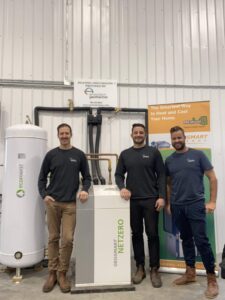
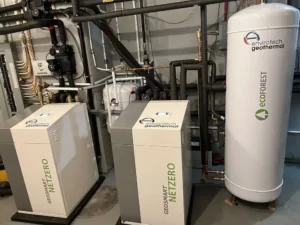
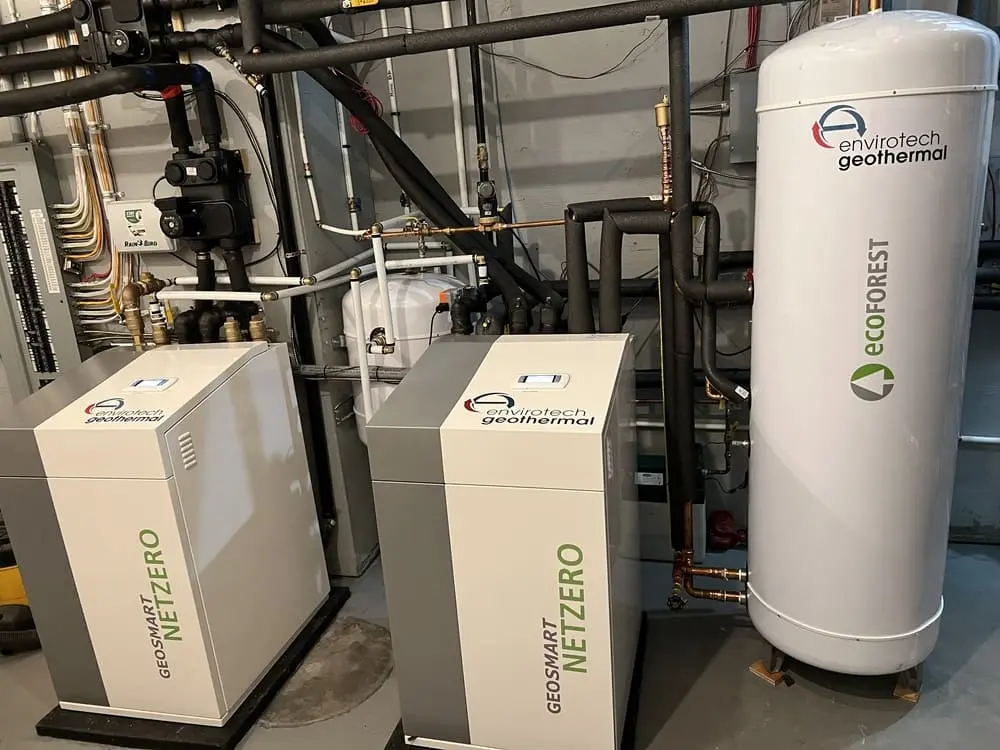
Discuss your heating and cooling projectFeatured image: GeoSmart NetZero equipment in an Envirotech installation near Calgary. Explore our geothermal project portfolio for real installation examples.
How geothermal cooling in Alberta works
In cooling mode, a ground-source heat pump moves heat out of the house. In a typical closed-loop system, a refrigerant circuit transfers that heat to fluid circulating through buried piping. The ground absorbs the rejected heat; cooled air or chilled water serves the building.
- 1. Remove indoor heatThe heat pump absorbs heat from indoor air or the building’s water circuit.
- 2. Transfer it to the loopHeat passes to circulating ground-loop fluid through a heat exchanger.
- 3. Release it undergroundThe buried loop transfers heat into the surrounding ground.
The ground below the zone most affected by weather changes temperature less than outdoor air. That can provide favourable cooling conditions during hot weather. However, neither the ground nor the circulating fluid stays at one fixed temperature everywhere in Alberta. Loop depth, soil conditions, system loads, and operating time affect performance.
The same loop can supply heat in winter when the system operates in heating mode. Learn more about the complete cycle in how geothermal heating and cooling works.
Active cooling and passive cooling: what is the difference?
Compressor operates
Active cooling
The heat pump uses its compressor to remove indoor heat and reject it to the ground loop. With a suitable indoor coil, it can also remove moisture from the air. This is the conventional cooling mode for a reversible ground-source heat pump.
Specially designed arrangement
Passive cooling
A compatible system transfers heat to the ground loop while bypassing the heat pump’s compressor. Circulation pumps, controls, and sometimes fans still use electricity. Cooling capacity depends on loop temperatures and the indoor equipment.
A design may combine passive and active cooling, but automatic switching depends on the controls and equipment selected. Confirm the actual sequence of operation in the quote rather than assuming every geothermal system offers both modes.
Geothermal cooling vs. conventional air conditioning
Central air conditioners and air-source heat pumps normally reject indoor heat to outdoor air. Geothermal systems use the ground or a suitable water source. Compare complete systems under comparable conditions instead of relying on a blanket savings percentage.
| Consideration | Ground-source heat pump | Central AC / air-source heat pump |
|---|---|---|
| Heat rejection | Ground loop or suitable water source | Outdoor air through an outdoor unit |
| Installation | Ground heat exchanger plus indoor equipment and connections | Outdoor equipment plus indoor coil or air handlers |
| Hot-weather performance | Depends on entering loop-fluid temperature, loop design, and equipment | Depends on outdoor temperature and equipment performance |
| Winter heating | Available with a suitable heating-and-cooling system | Air-source heat pumps provide heating; cooling-only AC does not |
| Best comparison | Installed cost, seasonal electricity use, maintenance, and whole-year comfort for your home | |
Geothermal can be attractive when a project needs a complete heating and cooling solution and has a suitable loop location. If the only goal is adding summer cooling to a home with effective heating, compare the extra ground-loop investment carefully. Our Alberta geothermal vs. air-source heat pump guide covers the wider choice.
How cooled air or water reaches your rooms
Homes with forced-air ductwork
A compatible water-to-air heat pump can deliver heating and cooling through the same ducts. Existing ductwork still needs an airflow and sizing assessment. Some retrofits need duct changes, electrical work, condensate drainage, or new controls. Cooling should appear explicitly in the installation scope.
Homes with radiant floor heating
Radiant heating does not automatically provide a practical cooling system. Chilled surfaces and piping can develop condensation when they fall below the indoor dew point. Ask the designer about separate cooling delivery, such as fan coils or a ducted air handler, and the moisture controls needed. Do not simply switch a heating floor loop to cold water.
Hydronic fan coils
A suitable water-to-water heat pump can supply chilled water to fan coils designed for cooling. Insulation, condensate drains, airflow, and zone controls are part of the design. The indoor distribution equipment matters as much as the ground loop.
Explore our residential geothermal services to discuss a configuration suited to your home.
Geothermal cooling costs and planning in Alberta
A useful quote separates the ground loop, heat pump, cooling distribution, electrical work, controls, and site restoration. When heating and cooling share equipment, assess the full-year benefit. Cooling may be included in a proposed system, but additional indoor equipment or installation work can still add cost.
Ask for projected seasonal electricity use based on your building’s cooling load and local electricity costs. Include circulation pumps and fans. Rated efficiency is useful for comparing equipment under stated test conditions; it does not guarantee a particular reduction in your bill.
Questions to ask before choosing equipment
- What are the calculated heating and cooling loads, including sunny rooms and upper floors?
- Which loop configuration fits the property, and what loop-fluid temperatures were assumed?
- How will cooling reach every occupied room?
- Does the design include active cooling, passive cooling, or both?
- How will the system manage humidity, drainage, and condensation?
- What maintenance, warranties, and commissioning checks are included?
For rural sites, read our Rocky View County acreage geothermal guide for ground-loop and property-planning considerations.
Operating and maintaining summer cooling
Follow the equipment’s instructions for filters, thermostat settings, and service intervals. Keep supply and return grilles clear and have cooling performance and condensate drainage checked when needed. Tell your installer if some rooms remain warm or if humidity becomes uncomfortable.
Some systems can recover heat for domestic hot-water preheating through an optional desuperheater or other heat-recovery arrangement. Confirm the equipment and tank connections included; this does not replace a complete water-heating plan.
Geothermal cooling in Alberta: frequently asked questions
Can geothermal cool an Alberta home in summer?
Yes. A ground-source heat pump designed for heating and cooling can remove heat from the home and transfer it to the ground loop. Capacity, loop design, and indoor distribution must suit the building.
Do I still need a separate air conditioner?
A properly designed geothermal system with compatible cooling distribution may cover your cooling needs. Homes with heating-only or radiant systems may need additional cooling equipment. Confirm the proposed configuration before installation.
Does every geothermal system provide passive cooling?
No. Passive cooling requires a compatible arrangement and suitable loop conditions. Many systems use compressor-driven active cooling. Ask the installer which modes the specified equipment actually supports.
Is geothermal cooling cheaper to run than central AC?
It can be, but savings depend on the equipment being compared, loop temperatures, cooling demand, and electricity costs. Request a seasonal estimate that includes pumps and fans rather than a universal percentage.
Can geothermal cooling remove indoor humidity?
Active cooling can remove moisture when air passes over a sufficiently cold coil with proper drainage. Passive cooling may provide less moisture removal. Humidity control needs to be considered in the system design.
Can an existing geothermal heating system be used for cooling?
Possibly. The heat pump, loop, distribution equipment, and controls need assessment. Do not assume a heating-only installation can cool without modifications.
See our geothermal FAQ for more general system questions.
Plan for comfort in every season
Discuss geothermal cooling for your Alberta home
Share your location, house plans or existing heating details, and the rooms you want to keep comfortable. Envirotech can help assess the ground loop, equipment, and cooling distribution your project needs.
Contact the Envirotech teamView our installationsTechnical references: Natural Resources Canada: Heating and cooling with a heat pump and U.S. Department of Energy: Heat pump systems. Equipment features and operating results depend on the specified system and installation.