
Propane Heating in Alberta: Costs, Challenges and a Geothermal Alternative
Heating a rural home or acreage with propane can be practical when natural gas is unavailable—but fuel deliveries, price changes and a heating-only system can make long-term planning difficult. Compare your options with an Alberta geothermal specialist.
Is propane a good heating choice for an Alberta home?
Propane heating is common on acreages, farms and rural properties beyond the natural-gas network. A propane furnace can provide dependable heat, but the complete decision includes more than the furnace itself.
Homeowners also need to consider delivered fuel prices, tank ownership or rental, refill scheduling, winter access, furnace efficiency, maintenance and whether a separate air-conditioning system is required. Alberta also regulates propane installations and storage through provincial gas codes and safety requirements.
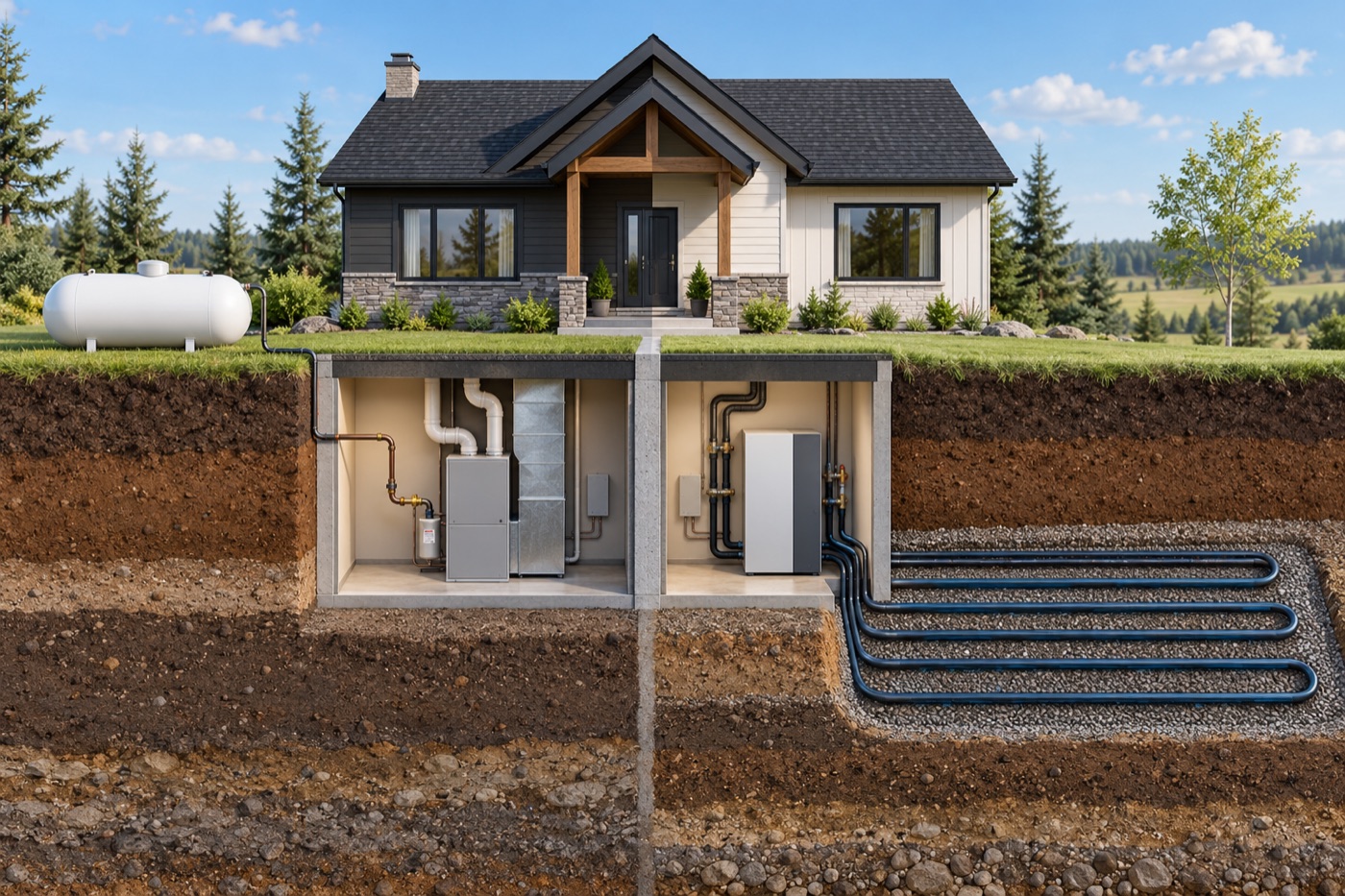
Four numbers determine what propane heating really costs
There is no honest province-wide annual cost that fits every property. The most accurate comparison begins with your own delivery history and your home’s heating load.
Annual litres delivered
Add the litres shown on your propane invoices for a complete 12-month period.
Delivered price
Include the fuel price, delivery charges, tank rental and applicable service fees.
Furnace efficiency
Older equipment may require more fuel to provide the same amount of usable heat.
Cooling and maintenance
Include separate air-conditioning, inspections, repairs and replacement planning.
Propane furnace vs. ground-source geothermal
The systems create comfort in different ways. Propane burns delivered fuel. A ground-source heat pump moves heat between the building and the relatively stable ground.
| Decision factor | Propane heating | Ground-source geothermal |
|---|---|---|
| Energy source | Delivered propane stored in an on-site tank | Electricity powers a heat pump that transfers ground heat |
| Winter planning | Tank level and delivery access need monitoring | No bulk heating-fuel deliveries |
| Heating and cooling | Furnace heats; cooling normally requires separate equipment | One system can provide both heating and cooling |
| Efficiency measurement | Measured as furnace fuel-utilization efficiency | Measured by coefficient of performance; Natural Resources Canada lists closed-loop market products in the 3.2–4.2 COP range under rating conditions |
| Property requirements | Tank location, code compliance and delivery access | Ground-loop area or drilling access, electrical capacity and accurate heat-loss sizing |
| Upfront investment | Generally lower for a straightforward furnace replacement | Generally higher because the project includes the ground heat exchanger |
| Long-term comparison | Depends heavily on delivered fuel use and price | Depends on design, electricity rates, loop type and building performance |
Efficiency ranges are general reference information from Natural Resources Canada. Actual equipment performance and savings depend on the selected system and property.
What does the conversion process involve?
A safe conversion is planned around the building—not a generic equipment size. Envirotech evaluates the complete heating and cooling requirement before recommending a system.
Review the property
Discuss propane usage, comfort concerns, renovation plans, available land, existing ducts and electrical service.
Calculate the load
Complete heating and cooling load calculations so the heat pump and ground loop are sized for the building.
Select the loop
Compare horizontal, vertical or suitable pond-loop options based on access, geology, water and project budget.
Plan the changeover
Coordinate installation, commissioning and propane-system decommissioning without interrupting essential heat.
When is geothermal worth investigating?
Ground-source geothermal deserves a closer look when several of the following conditions apply:
- Your property has no practical natural-gas connection.
- You currently rely on propane, heating oil or electric resistance heat.
- You expect to own the property long enough to value lower operating exposure.
- You need both winter heating and summer cooling.
- Your acreage has room for horizontal loops, or the site can accommodate vertical drilling.
- Your existing propane furnace or air conditioner is approaching replacement.
- You want to remove routine fuel-delivery and tank-management requirements.
How Envirotech compares your options
We do not promise a standard percentage saving. Instead, a useful assessment compares your actual propane consumption with a model of the proposed geothermal system.
- At least 12 months of propane and electricity bills
- Building size, insulation and heat-loss characteristics
- Existing ductwork or hydronic distribution
- Ground-loop type and installation access
- Expected geothermal electricity use
- Maintenance, cooling and equipment-replacement costs
- Financing and currently available incentive eligibility
Propane heating questions from Alberta property owners
How much does propane heating cost in Alberta?
Your annual cost depends on the litres delivered, your delivered price, tank and delivery fees, furnace efficiency, home heat loss and winter conditions. Use a complete year of invoices rather than a single refill or advertised per-litre price.
What are the disadvantages of propane heat?
Common considerations include fuel-price changes, delivery scheduling, tank ownership or rental, storage and code requirements, and the need for separate cooling equipment. These are planning factors rather than proof that propane is unsuitable for every property.
Can geothermal completely replace a propane furnace?
In many homes, yes—but only after proper load calculations, duct or hydronic review, electrical assessment and ground-loop design. Some projects may retain backup heat depending on the building and design strategy.
Does geothermal work during extreme Alberta cold?
A ground-source system exchanges heat with the ground rather than cold outdoor air. Correct sizing and loop design are essential. Review our guide to geothermal performance at −30°C.
Can I use my existing ductwork?
Often, but it needs to be checked for the airflow required by the selected heat pump. Envirotech reviews duct sizing, condition and distribution during project planning.
What happens to the propane tank?
Tank removal or decommissioning should be coordinated with the tank owner, propane supplier and qualified contractors. Alberta propane installations and storage are governed by applicable safety codes. See the current Alberta gas codes and standards.
Is geothermal always cheaper than propane?
No universal claim is responsible. The outcome depends on the property, system design, loop cost, electricity rate, propane consumption, financing and ownership period. A bill-based assessment provides a more defensible answer.
Helpful Alberta geothermal resources
Ready to compare your propane bills with a geothermal plan?
Bring your recent propane and electricity bills. Envirotech will help you evaluate loop options, system sizing and the next practical step for your Alberta property.