
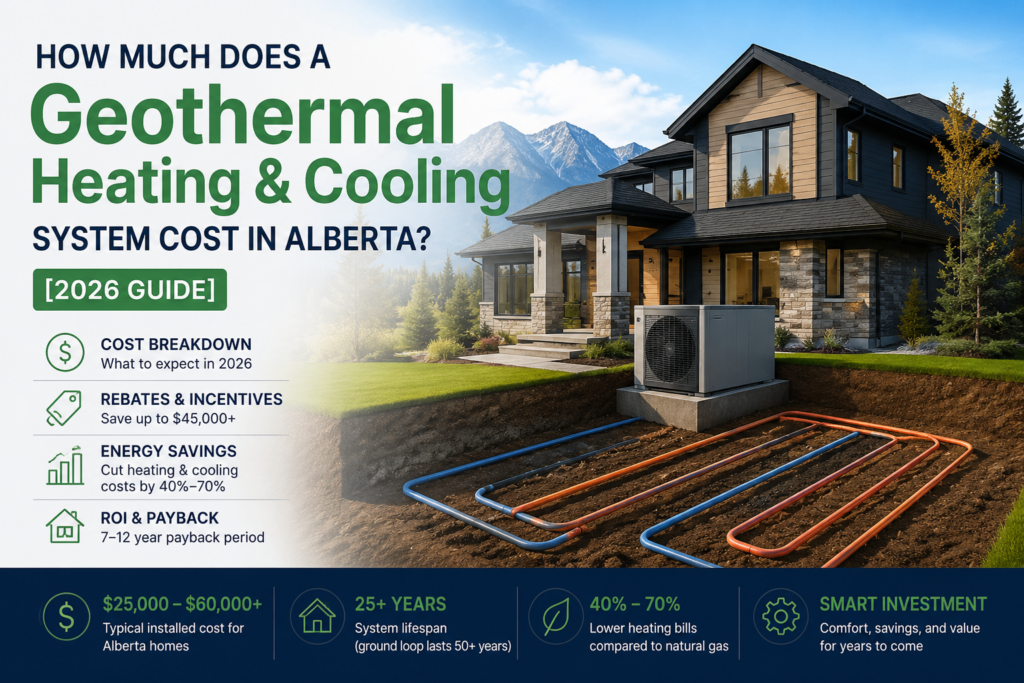
If you’re researching geothermal heating and cooling for your Alberta home or commercial building, the cost is probably the first thing you want to know. The short answer: a residential geothermal system in Alberta typically costs between $25,000 and $60,000 installed. But that number alone doesn’t tell the full story.
This guide breaks down exactly what drives the cost, what rebates and grants are available in 2026, and what kind of return on investment you can realistically expect — so you can make an informed decision before picking up the phone.
Average Geothermal System Cost in Alberta (2026)
The cost of a geothermal system in Alberta varies based on the size of your home, the type of ground loop system, and your property’s soil and land conditions. Here are the general benchmarks for 2026:
- Horizontal ground loop systems: $5,000 – $7,000 per ton
- Vertical ground loop systems (drilling required): $7,000 – $9,000 per ton
- Average 3-ton residential system: $30,000 – $50,000 fully installed
- Large homes or high-end systems: up to $60,000+
Most Alberta homes between 1,500 and 3,000 sq ft require a 3 to 4-ton system. Keep in mind the total price includes the heat pump unit, the ground loop installation, labour, and integration with your existing ductwork or hydronic system.
Cost by System Type
The type of ground loop has the biggest impact on your final price. Here’s how each compares:
| System Type | Cost Per Ton | Avg. Total Cost | Best For |
| Horizontal Loop | $5,000 – $7,000 | $25,000 – $45,000 | Rural homes with yard space |
| Vertical Loop | $7,000 – $9,000 | $35,000 – $60,000 | Urban/suburban, limited yard |
| Pond/Lake Loop | $4,000 – $6,000 | $20,000 – $35,000 | Properties near water |
| Open Loop | $3,500 – $5,500 | $18,000 – $30,000 | Near freshwater well |
For most Edmonton-area homes with a standard backyard, a horizontal loop is the most cost-effective option. Urban infill properties with limited yard space — common in Calgary and central Edmonton — will typically require vertical drilling, which increases the cost but remains the most practical solution.
6 Factors That Affect Geothermal Installation Cost in Alberta
1. Home Size and Heat Load
Bigger home, bigger system. A 2,000 sq ft home generally needs a 3-ton unit while a 4,000 sq ft home may require 5 tons or more. Every professional installer — including Envirotech — starts with a heating load calculation based on your floor plan, insulation levels, and window efficiency before sizing the system.
2. Ground Loop Type and Depth
Horizontal loops require trenches (typically 6 feet deep, 300 feet long per trench) and more land. Vertical loops require drilling boreholes 150–400 feet deep. Drilling adds cost but is often the only option in urban Alberta settings where lot sizes are smaller.
3. Soil and Geological Conditions
Alberta’s soil composition varies significantly across the province. Rocky or clay-heavy ground can slow drilling and increase labour time. Sandy or loam soil is easier and faster to work with. Properties in areas like Drayton Valley or rural Vegreville often have ideal conditions for horizontal systems, while Edmonton’s urban core typically requires vertical loops.
4. New Build vs. Retrofit
Installing geothermal during new construction is significantly cheaper because the ground loop goes in before landscaping and the mechanical room is designed around the system. Retrofitting an existing home adds cost for loop installation around existing landscaping and potentially upgrading ductwork if your current system is undersized.
5. System Efficiency and Features
Geothermal heat pumps range from 15 EER (Energy Efficiency Ratio) to 45+ EER. Higher-efficiency units cost more upfront but save more on operating costs each year. Features like remote monitoring, Wi-Fi controls, and desuperheaters (which heat your domestic hot water as a byproduct) add cost but improve the system’s overall value.
6. Residential vs. Commercial Scale
Commercial geothermal systems — used in office buildings, schools, multi-family housing, and industrial applications — operate on a much larger scale and are priced accordingly. If you’re a developer or property manager, visit our commercial geothermal page for project-specific information and to request a commercial quote.
Alberta Geothermal Rebates & Incentives Available in 2026
The upfront cost of geothermal looks very different once you factor in available government programs. Alberta homeowners in 2026 have access to several stacking incentives that can reduce your net cost by $15,000 to $45,000:
| Program | Amount | Who Qualifies |
| Canada Greener Homes Loan | Up to $40,000 (0% interest) | Canadian homeowners |
| Clean Technology ITC (Federal) | 30% refundable tax credit | Residential & commercial |
| CEIP – Clean Energy Improvement Program | Financing via property tax | Alberta homeowners |
| HERA – Edmonton | Up to $20,000 rebate | Edmonton homeowners |
| BERA – Commercial Edmonton | Commercial retrofit rebate | Edmonton commercial buildings |
| CMHC Eco Plus (New Builds) | 25% mortgage premium refund | New construction buyers |
These programs can be stacked in many cases. For example, an Edmonton homeowner could combine the Canada Greener Homes Loan ($40,000 interest-free) with the CEIP financing and the HERA rebate — dramatically reducing the out-of-pocket cost on day one. Envirotech helps clients identify which programs they qualify for as part of the quoting process.
Operating Costs and Energy Savings
A geothermal system doesn’t just heat and cool — it replaces natural gas, propane, or electric baseboard heating entirely. Here’s what Alberta homeowners typically experience after switching:
- 40% to 70% reduction in annual heating bills compared to natural gas
- 50% reduction in cooling costs compared to central air conditioning
- Domestic hot water heating included at no extra fuel cost (with desuperheater)
- No outdoor compressor unit — no freeze risk, no wind damage, no noise
On a typical Alberta home spending $3,000–$4,500 per year on natural gas heating, geothermal can reduce that to $900–$1,800 per year in electricity to run the heat pump. Annual savings of $1,500–$2,500 are realistic for most homeowners.
Return on Investment and Payback Period
The payback period for a geothermal system in Alberta — after rebates — typically falls between 7 and 12 years. Here’s a simple illustration:
- System cost: $40,000 installed
- Minus rebates and incentives: -$15,000
- Net cost: $25,000
- Annual energy savings: $2,000/year
- Simple payback: ~12.5 years
- System lifespan: 25 years (indoor components) to 50+ years (ground loop)
That means 12 to 37 years of essentially free heating and cooling after the payback point. No other heating system offers this combination of longevity and operating cost reduction.
Beyond energy savings, geothermal systems also add measurable value to your property. Homes with geothermal are increasingly attractive to energy-conscious buyers, and in Alberta’s climate — where heating bills are a real concern — it’s a compelling selling feature.
Is Geothermal Heating Worth the Cost in Alberta?
For Alberta specifically, the answer is almost always yes — for homeowners planning to stay in their home for 8+ years. Here’s why Alberta is one of the best places in Canada to invest in geothermal:
- Extreme temperature swings (-30°C winters, +30°C summers) mean heating AND cooling costs are significant — geothermal addresses both with one system
- Underground temperatures in Alberta remain stable at 4°C–10°C year-round, making geothermal highly efficient regardless of air temperature above ground
- Natural gas prices in Alberta have risen steadily — geothermal locks in low operating costs regardless of gas prices
- Alberta’s wide open rural land provides ideal conditions for lower-cost horizontal loop systems
- Available incentive programs in 2026 are the strongest they have ever been
If you’re building a new home, geothermal is the single smartest mechanical decision you can make. For homeowners considering a residential geothermal system, the combination of energy savings, comfort, and long-term ROI is hard to beat anywhere in Canada — and particularly strong in Alberta’s climate.
Frequently Asked Questions
What is the cost of geothermal heating per square foot in Alberta?
A rough rule of thumb is $12 to $20 per square foot for a fully installed system, including ground loop. A 2,500 sq ft home would fall in the $30,000 to $50,000 range before incentives.
How long does a geothermal system last in Alberta?
The indoor heat pump unit typically lasts 20–25 years with basic maintenance. The ground loop — buried plastic piping — is rated for 50+ years and comes with manufacturer warranties to match. You may replace the heat pump unit once before the loop ever needs attention.
Can geothermal handle Alberta’s -30°C winters?
Yes. This is one of the most common misconceptions. Geothermal doesn’t pull heat from outside air — it pulls it from the ground, which stays above freezing all year. Performance does not degrade in extreme cold the way air-source heat pumps do.
Do I need a backup furnace with geothermal in Alberta?
Most properly designed geothermal systems in Alberta do not require a backup furnace. The system is sized for your heat loss at design temperature. Some homeowners opt for a small backup electric element (built into most heat pump units) for extreme cold snaps, but this is rarely used.
Get an Accurate Quote for Your Home or Project
Every geothermal project is different. The best way to get an accurate cost for your specific home, land, and heating needs is to speak with an experienced installer. Envirotech Geothermal has been designing and installing systems across Alberta since 2006 — residential, commercial, rural, and urban.
Call us at 1-866-464-3287 (1-866-GO-HEATS), or complete our quick online quote form to get a budgetary estimate in under 60 seconds. For commercial projects or multi-family developments, visit our commercial geothermal page to get in touch with our commercial team directly.