Alberta homeowner guide
Existing furnace ductwork may be reusable for a heat pump, but it needs an assessment. Heat pumps can supply air at a different temperature and airflow than the furnace they replace. The right question is whether the complete distribution system can deliver the required heating and cooling comfortably.
Discuss your projectStart with the room loads and equipment requirements
A duct assessment should connect the home’s heating and cooling loads to the selected equipment’s airflow requirements. Counting vents or matching the old furnace size does not establish whether the existing system is suitable.
Natural Resources Canada notes that heat pumps generally supply a greater volume of air at a lower temperature than furnace systems. That difference can affect duct sizing, comfort and the experience of air coming from a register.
Ask for a room-by-room review when the home has cold bedrooms, an overheated main floor or a finished basement with weak airflow. These problems may become more noticeable after an equipment change. Our system sizing guide explains why distribution should be considered alongside capacity.
Check return air as carefully as supply air
Supply ducts move conditioned air into the rooms; return paths bring it back to the equipment. A restricted return can limit the airflow through the system even when the supply grilles look adequate. Closed bedroom doors can also change how air moves.
The assessment should identify return locations, obstructions and the intended path from each served area. Solutions may involve return modifications, transfer paths or balancing, depending on the building and applicable requirements. Ask the installer to explain the proposed approach.
Keep grilles clear of furniture and avoid closing numerous registers to force air elsewhere. Those changes can increase resistance rather than solve the underlying problem. A distribution review is more useful than trying to adjust the system by guesswork.
Ask about measured airflow and pressure
Duct size, fittings, filters and coils all create resistance to airflow. A technician can evaluate the system against the selected equipment’s requirements and check operating measurements during commissioning. The appearance of a large main duct alone does not confirm acceptable performance.
Ask whether the quote includes duct modifications and how their success will be checked. Useful handover information includes the configured airflow, filter requirements and relevant test results. Measurements should be interpreted using the manufacturer’s limits for the actual equipment.
A higher-resistance filter can change operating conditions. Use the approved filter size and type, and discuss air-quality goals before choosing a denser filter. If the system cannot support the desired filtration, a separate solution may be more appropriate than restricting the main air path.
Plan cooling, drainage and controls together
A heating retrofit that adds cooling introduces additional requirements. The design needs to consider the cooling load, coil and air handler configuration, condensate removal, insulation where required, and appropriate controls. Existing ducts may need changes even if winter heating has been acceptable.
Geothermal equipment must be configured for the cooling function being proposed. Air-source equipment also needs a suitable outdoor location and the applicable electrical and mechanical approvals. Our geothermal cooling guide describes how cooling reaches the rooms.
If the home uses radiant heating, it may have little or no existing ductwork for cooling. Discuss fan coils, a separate ducted system or other suitable options with the designer. Chilled water through a heating floor is not an automatic replacement for a properly designed cooling system.
Compare the practical retrofit options
| Approach | Main question |
|---|---|
| Reuse existing ducts | Can they deliver required airflow within equipment limits? |
| Modify returns or branches | Which rooms and restrictions need attention? |
| Replace selected duct sections | Can access and renovation plans accommodate the work? |
| Alternative distribution | Would ductless, fan-coil or designed high-velocity equipment suit the building? |
Each choice has different construction implications. A finished basement may make some alterations difficult; planned renovations can create an opportunity to improve distribution. Envirotech’s HVAC services and air-source heating and cooling options provide context for a property-specific discussion.
Get the permit and commissioning scope in writing
In Edmonton, permit requirements vary with the work. Review the City’s heating and ventilation permit guidance and confirm who handles the applicable approvals and inspections. Avoid assuming that replacing equipment means every part of the project is permit-free.
After installation, ask for testing of heating and cooling modes, a review of airflow and controls, and a demonstration of normal operation. The goal is a complete comfort system that meets the design, not simply a new appliance attached to old ducts.
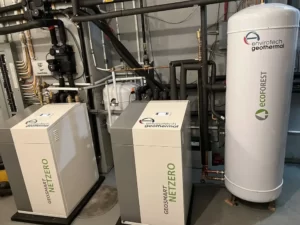
Bring photos of the mechanical room, a list of problem rooms and renovation plans to your assessment. The Edmonton heating upgrade checklist helps organize the broader questions before choosing equipment.
Common questions
Do all heat pump retrofits require new ducts?
No. Some existing systems can be reused; others need modifications. A load and airflow assessment determines the appropriate scope.
Why does heat pump air feel less hot than furnace air?
A heat pump may deliver lower-temperature air for longer periods. Comfort depends on delivered capacity and distribution, not register temperature alone.
Can closing vents improve a cold bedroom?
It can increase system resistance and may not fix the problem. Ask for balancing and a review of the return path.
Continue your research
Explore the Alberta geothermal learning centre for connected guides on design, comfort, installation and costs.
Plan with Envirotech Geothermal
Bring your property details, existing equipment information and questions to a discussion with the Envirotech team.
Contact EnvirotechExplore residential geothermalPrepared by Envirotech Geothermal Team. Technical or planning reference: City of Edmonton guidance. Reviewed October 4, 2026.